Essay
When the Web Was Young
There was a time when the Web was a strange new place. Not strange the way it can be strange today — not because of social media, algorithms, pop-up ads, misinformation, or whatever new corner of the Internet has gone off the rails this week. I mean strange because nobody really knew what it was. There were no conventions yet, no settled rules about what a website was supposed to look like. Nobody had written the book on how to build for the Web, because in a lot of ways the book hadn't been written. In that strangeness was also a prevailing optimism about the endless possibilities, and that was exciting.
There were websites, of course. But they felt less like destinations and more like discoveries. You might find a page because someone handed you an address. You might follow a link just to see where it went. You might stumble onto something made by a person halfway around the world and realize, maybe for the first time, that you were looking at something they had built and put out there for anyone to see. Anyone. That was the part that felt almost magical. Today it all feels normal and obvious. Back then it was astonishing and, I'll say it again, really exciting.
And somewhere in the middle of all of that, I found myself, though I didn't realize it for years. I didn't set out to become a Web designer. I didn't have a long-range career plan (I didn't even have that when I graduated college three years earlier). I didn't look at the early Internet and announce that I was going to build a career on it. I was just curious, fascinated, and motivated. Curiosity turned out to be a pretty good way to approach the future.
I can still remember what it felt like to be introduced to the Web when it was young. The technology itself wasn't glamorous. There were no glossy apps, no infinite feeds, no smartphones, no video streaming, no search engines that seemed to know everything (although they already knew quite a lot of what was available to know). At first, there wasn't even a graphical browser. You could sit in front of a computer, type a few commands, and suddenly you had access to some other place — some other fountain of knowledge. That was the revelation. The distance between you and information had changed. You weren't just reading a book or looking something up in an encyclopedia. You were moving through a network of connected information. Someone, somewhere, had made a thing, put it on a computer, and now you could reach it. The Web wasn't only information. It was the ability to go to places. And once I grasped that concept, the obvious next question was: how did they make this, and can I do it?
That question changed everything. Learning HTML eventually became a multi-year obsession, but there was something wonderfully primitive about it at first. You didn't need a giant software package or a development team. You could open a text file in Notepad and start typing.
<HTML>
<BODY>
<H1>
And eventually, somehow, those commands (tags, I learned they were called) turned into a page. The first time you made something show up in a browser, you understood something: you weren't just visiting the Web anymore. You were putting something into it. That was an intoxicating thing to realize. I could design a page for anyone in the world to see.
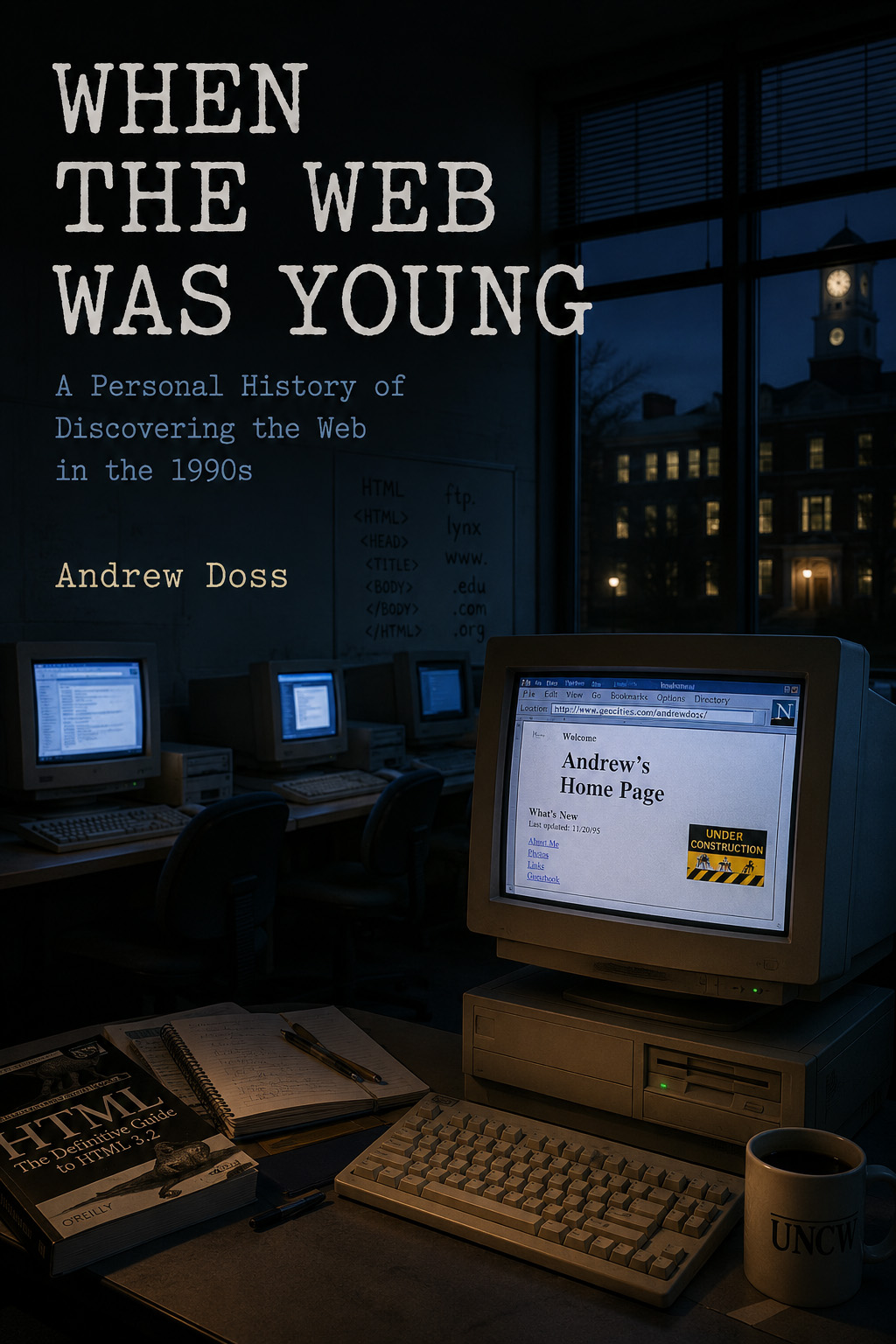
Because the Web was still so young, there was another advantage. Nobody knew exactly what they were doing. The people building websites professionally knew more than the rest of us, sure, but there wasn't a universally accepted definition of what "good Web design" even meant yet. Everyone was experimenting. People were trying animated graphics and strange backgrounds and blinking text and frames and hit counters and guestbooks — things that might make a modern designer recoil in horror. And there was a real freedom in that. We were making it up as we went.
One of the things I figured out early was that if I found a website I liked, I could look at its source code. And there it was — the machinery behind the curtain. You could see exactly how somebody else had put together the thing you were looking at. So I took things apart. I copied things, changed things, broke things, and then figured out why they were broken. That was how I learned. There was no YouTube video waiting to walk me through it, no AI assistant to explain the code, no giant community answering every question I had. There was only a browser, a text editor, source code (mine or someone else's), and curiosity. That was enough, and I immediately started building pages and sites based on my own interests, experimenting along the way.
Eventually the experiments became true projects, the projects became opportunities, and the opportunities became work. Without really meaning to, I started building things for other people. There were websites for organizations, sites tied to school and academic work, projects that began as experiments and turned into things people actually used. I worked with a team that built the site for the Master of Arts in Professional Writing program at Kennesaw State University. It was really my first project, and it was a huge deal at the time. Looking back at it now, it feels like an artifact.
I wouldn't have thought much about it if Bridget hadn't been telling me for years that I should tell my story: the story of my own experiences with the early Web, the things I remembered that many people do not, how I've come full circle with websites, and how important preserving this story could be.
That's one of the strange things about getting older. You eventually realize that some of the things you thought were huge were actually fairly inconsequential, and some things you thought were temporary actually weren't. They were evidence. A pile of HTML files sitting on a computer could quietly become a time capsule. A screenshot could tell you what people thought a website was supposed to look like in 1997. An old graphic could remind you what the technology could and couldn't do. A forgotten page could show you what mattered to people at a particular moment. And a directory full of files could hold a whole version of yourself. The person who made those things had no idea he was making history. Neither did anyone else. That's probably true of most history. Nobody wakes up on an ordinary Tuesday and thinks, today I am creating an artifact that someone will want to dig up thirty years from now (if they do, it's often not true). For the most part, you just live your life. You make things, save some of them, throw others away, and then time passes.
The early Web had another quality that's easy to forget now: in a way, it felt permanent. We had no reason to think it wasn't. If you put something on the Web, it was out there, somewhere. You could hand someone the address, they could type it in, and there it was. But sometimes the Web has a terrible memory, despite the Wayback Machine. Websites disappeared. Servers got shut down. Companies changed names. People stopped paying for domains. Hard drives died. Organizations redesigned their sites and threw the old ones away. People moved on. Sometimes the only proof that something had ever existed was a forgotten file on someone's computer, or a screenshot, or a link in an old document that no longer went anywhere.
That hit me differently than I expected, because I had been there. I wasn't looking at some distant technological era preserved behind museum glass. I was looking for things I remembered. Things I had made. Things other people had made. Things that had once been real places on the Web. And some of them were simply gone.
So I started digging — old files, old folders, old graphics, old hard drives, old memories. The Internet Archive became something more than a place to look up an old website. It became a kind of archaeological site. You could type in an address from twenty or thirty years ago and sometimes find a snapshot of the past. Not always. Sometimes there was nothing. Sometimes the images were missing, or the links led nowhere, or you'd find the shell of a website but not the thing you were actually after. But every so often something would surface — a page, a logo, a sentence, a photograph you hadn't seen in decades. And suddenly the past wasn't abstract anymore. It was right there on the screen. That was when I started to understand that this wasn't really a story about computers. It was a story about memory.
One of the most surprising things about going back through my own digital history has been how much of my life was hiding in plain sight. There are projects I had completely forgotten. There are things I remember making but can't find anymore. There are things I never thought mattered that now seem important. Even something like my old "Best Quads 1985" project from my high school marching band days can mean something more once enough time has passed, because the object itself isn't really the point. The point is what it carries — a name, a person, a place, a particular year, a particular version of me. The Web turned out to be a strange kind of memory machine, and we had no idea at the time. We thought we were publishing information. We didn't realize we were leaving breadcrumbs behind for our future selves — and hopefully for others to discover.
Then there's the larger story. The more I look back, the more I see that my early Web experiments weren't isolated events. They were the start of a career I didn't know I was starting. The path wasn't straight, and there was no grand strategy behind it. It was more like a hallway of doors. I opened one because I was curious, and behind it was another, so I opened that one, and then another. Sometimes doors opened for me. Sometimes hallways went in strange directions I couldn't have predicted. Eventually I was doing things professionally that had started as things I did simply because I wanted to understand how they worked. That's one of the great gifts of being around when a technology is young. The boundaries haven't hardened yet. You don't have to decide whether you're a designer, a developer, a writer, a producer, a strategist, or a technologist. You can be all of them. You can make things because making things is interesting and fun. And sometimes the thing you make becomes the thing you do. That's a real blessing.
That's probably why the early Web still feels so vivid to me. It wasn't just new technology. It was a stretch of time when possibility was visible. You could watch the rules being invented. You could watch people experiment. You could try something and find out that nobody had ever told you that you weren't supposed to do it. The Web hadn't become an institution yet. It was an optimistic frontier, and frontiers are exciting partly because they're unfinished. Today we live inside the finished version of a lot of those experiments. We don't think about the machinery underneath. We don't marvel that someone in another country can publish something and we can see it seconds later. We just tap a screen. The magic became our assumed infrastructure, taken for granted every moment.
And now, decades later, I'm watching another technology show up that gives me a familiar feeling. Artificial intelligence obviously isn't the same thing as the early Web — the technologies are different, the implications are different, the scale is different. But I recognize the sensation. People are experimenting. Nobody fully agrees on what the conventions should be. People are building things that didn't exist before. Some of it is brilliant. Some of it is ridiculous. Some of it will disappear. And some of it will become so ordinary that future generations will wonder how we ever lived without it. I was introduced to it, and I was skeptical or, dare I say, frightened at first, but once I dug in and started creating, that same spark reignited in me. Somewhere in the middle of all that, I keep thinking about the younger version of me sitting in front of a computer, staring at a strange little network and wondering how it worked. I didn't know I was looking at the beginning of something enormous. I just knew it was interesting and fun, so I pursued it.
That's what I want to remember — not simply the technology, not the browser wars or the software or the technical milestones, not a timeline of when one company launched something and another company bought something else. Those things mattered at the time, but they aren't the story I remember living. I remember the feeling: discovering you could make something and put it somewhere other people could see it, finding a page somebody else had made and realizing you could follow a link into a world you'd never seen, looking at source code and understanding that the thing in front of you wasn't magic. Someone had built it. Which meant, maybe, that you could build one too. I remember the weirdness of websites that didn't quite work, the excitement of seeing your own page online, the hours spent figuring out why an image wouldn't load, the primitive graphics, the ridiculous ideas, the experiments, the people, the enigmas, the things we built just because. And, more and more, the things we lost.
Because that's the other lesson buried in all of this. The Web may be one of the largest collections of human expression ever made, but huge portions of it are already gone. We didn't preserve it because we didn't think of it as history. We thought we were just using it. Maybe that's why some of these old pages feel so precious now. They aren't just webpages. They're evidence that we were there.
When I started looking back, I thought I was going to just remember some old websites. What I found was a version of myself (a version that still exists and responds to new and exciting things, though with a hopefully more experienced perspective). And along the way I enjoyed discovering that I wasn't the only one. There were thousands — millions — of people doing the same thing. Teachers making their first class pages. Fans building fan sites. Students publishing their first experiments. Musicians putting songs online. Businesses trying to work out what a homepage was even supposed to be. Kids discovering HTML. Artists messing with digital media. People building communities before anyone had invented the vocabulary for online communities. We were all part of something much bigger than we understood. We were building the world we all live in now, and sometimes the landscapes of that world were (and are) treacherous, but most of the time, the thrill of exploring something new is ever-present.
That's what it was like when the Web was young. It wasn't polished. It wasn't predictable. It wasn't always pretty. But it was ours to explore. And for a brief moment, it was small enough that an ordinary curious person could stumble into it, take it apart, build something of their own, and become part of its story. I was one of those people. This is what I remember.