Essay
Hearthglow
When I was a child, visiting with grandparents, one thing I always loved was being inside while the adults sat out on the deck in the evening after dinner, mostly in the dark, talking and laughing. My dad would often say something that would tickle my grandfather, and hearing the laughter was a comforting feeling. Sometimes it was the opposite: I'd be in the dark, and the family would be apart from me, in the light, but in both cases, I didn't have to participate. I could just enjoy the feeling of their proximity and the indefinable comfort it brought just knowing that other humans were having an experience outside of my own.
It's the same when I'm in one part of the house, working on music, or on other projects, while my wife watches television in another part of the house. Maybe she's watching something funny, and I hear her laugh. The knowledge and experience of being apart from her while she does her own things, enjoying herself, while I'm perhaps in a darker, quieter space, but hearing her, and maybe seeing the light from the room she's in, evokes a feeling I've loved since childhood.
While walking on a sidewalk, I took a picture of the side of a house at night because of the light. There's nothing remarkable about the scene. A wooden deck sits behind a slatted wall, surrounded by trees and the ordinary dark of an evening. A few small lamps mark the path below. Perhaps the suggestion of faint sound coming from within. If I described it to you flatly, you'd have no reason to look twice.
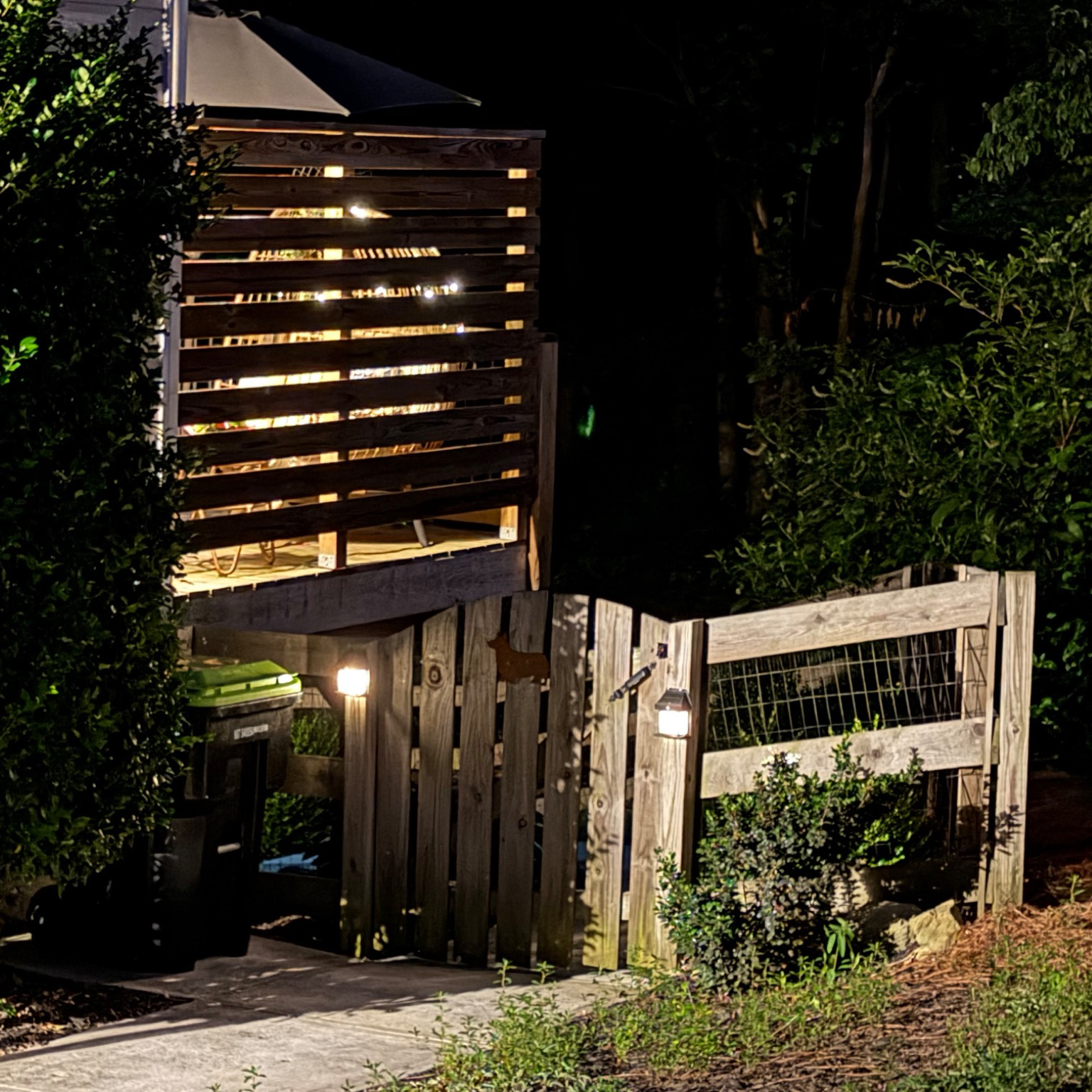
But look through the slats. There's warm light up there. The edge of a chair, maybe. A table. A few shapes I can't quite resolve into anything. I couldn't tell you what was happening on that deck, or whether anyone was even on it when I snapped the photo. And somehow I found the whole thing comforting. I've been trying to work out why ever since.
I don't know who lives there. I don't know if they were sitting out with a drink, or talking, or listening to music, or doing absolutely nothing at all. All I have is the light, and the light is enough to suggest a life happening just beyond where I could see. I've realized I love that feeling, and I've felt it in a hundred places I never bothered to name.
Walking through a neighborhood at night and catching a kitchen glowing behind a curtain. Driving past a house where a single upstairs window is lit and nothing else. Seeing a restaurant from across a dark parking lot. Hearing voices come from another room while I sit alone in mine. Walking in the woods and finding, between the trees, the warm square of a cabin window. None of these things were happening to me. That's the part I keep coming back to. I wasn't inside the house. I wasn't at the table. I wasn't in the conversation. I was simply aware that someone else's world was there, running along quietly beside my own.
You'd think there would be something lonely in that. I'm outside, they're inside; their evening is invisible to me and mine is invisible to them. But it's the opposite. Their presence is what makes the night feel less lonely, not more. I don't need access to someone's life to be reassured by the fact of it. The unseen people aren't performing for me. They aren't interacting with me. They almost certainly have no idea I'm there. And still, their existence says the plain, steadying thing: the world is inhabited, ordinary life is going on, dinner is being made somewhere and it isn't a crisis.
The slatted wall turns out to matter more than the light. If the whole deck were open to view, I'd just be looking at a stranger's backyard, and I'd probably feel like I ought to look away. If the wall were solid, there'd be nothing at all — a fence, and behind it, who knows. What the slats give me is fragments. A strip of gold. The corner of a chair. A shadow that might have moved, or might only have moved because I wanted it to. That's just enough for my mind to build the rest. I don't know there's conversation up there. I don't know anyone's laughing or pouring wine. But the gaps hand my imagination the raw material, and it fills in a whole evening. That may be the exact reason it's comforting. The wall keeps their privacy and lets the warmth leak out, both at once, and the boundary itself becomes part of what I'm feeling.
Here's the larger thing underneath it, the part that makes this more than a nice observation about pretty lights. Every person I pass is carrying a world I'll never see. Every lit window holds a life that has, for the most part, nothing to do with me. Behind those walls there are arguments and dinners and kids being put to bed, music, unpaid bills, a dog being fed, somebody sitting quietly and staring at a phone. Whole evenings unfold that I will never enter. And knowing that — really letting that reality land — makes my own small corner of the world feel bigger rather than smaller. Does that make sense?
There's a word that gets close to this. Sonder — the realization that everyone around you has an inner life as vivid and tangled as your own. But that's not quite it. Sonder is about recognizing that other people are real, and that's a fine thing to recognize, but what I'm describing is more specific. It's the comfort of sensing those lives continuing nearby without any need to step into them. Not "other people exist," but "other people being there, just out of reach, is a good and steadying thing." I looked at the cozy words too. Hygge is mostly about the coziness itself. Gezelligheid carries the warmth and the company. None of them names this particular thing — the quiet reassurance of unseen life happening somewhere just past your own.
In recent years, many of us have learned the word liminal — existing on a boundary, in a transitional state, or at a threshold between two different places, stages or conditions. I think of it as spaces that serve as intermediate passages to other places. The knowledge that the other places exist, and there are people there having lives of their own while I exist in the liminal space gets close to the feeling I mean.
Maybe it needs a word. Maybe it doesn't; sometimes putting your finger on a feeling is more satisfying than christening it. But if I had to pick one, I'd build it around the word hearth, because the feeling isn't really about illumination. It's about the presence of home. So, I'll call it hearthglow — the comfort of glimpsing the warmth of another inhabited world without being part of it. The light isn't an optical event, it's evidence. Somebody's life is on the other side of those slats, and the glow is proof. Somehow, that also seems to prove my own existence.
That's what I see now when I look at the photograph. A deck. A fence. A few lights. I still don't know what was on the other side. Maybe nobody. Maybe someone at a table with a drink, talking, or listening to something, or doing nothing at all. I'll never find out, and that's fine, because the picture was never supposed to show me their world. It only had to remind me the world was there. Sometimes it's comforting just to see the light.
More Writing

When the Web Was Young
Learning HTML by taking other people's pages apart, stumbling into a career, and going looking, decades later, for the pages that vanished.
Read →
The Album My Sister Didn't Want
How a hand-me-down record my sister won off the radio and didn't even want set a five-year-old on a lifelong path with music.
Read →